
When Optimization Becomes Destiny
AI, genetic engineering, and the question of who gets to define improvement - thoughts from the Global Dialogue on AI Governance in Geneva

Most conversations about AI governance begin with familiar questions: safety, bias, misinformation, jobs, security, power. But they are not the only questions AI is beginning to raise.
As AI moves deeper into science, medicine, and biotechnology, governance will have to confront something more fundamental than model behavior. It will have to ask what these systems are being used to predict, rank, optimize, and ultimately make possible.
Which is where genetic engineering enters into the conversation. Genetic engineering is not separate from AI governance. It is one of the places where the deepest questions of AI governance become tangible. What happens when AI is used to interpret genomes, identify biological patterns, accelerate drug discovery, and predict biological outcomes? What happens when the incredible advances we are making in biotechnology can then turn those predictions into interventions in bodies, reproduction, disease, inheritance, and human possibility?
The more powerful a technology becomes, the more imagination governance requires.
Biotechnology is not only about biology. As it moves into clinics, datasets, fertility care, research platforms, insurance systems, and public health, it becomes infrastructure. And infrastructure becomes culture: a story about what kinds of lives are valued, protected, improved, or prevented.
One place this becomes especially visible is women’s health, because reproduction is where many of these questions become tangible. Eggs, embryos, fertility treatment, prenatal testing, surrogacy, genetic screening, reproductive labor. These are not abstract ethical debates. They are choices made in clinics, families, and markets, often under conditions of uncertainty, hope, fear, and unequal access.
But there is also a deeper connection to the themes of myth and technology. Every society develops narratives about human improvement. Today, AI and biotechnology are increasingly intertwined in that story. AI systems help identify patterns in genetic data, predict biological outcomes, and accelerate discovery. At the same time, they inherit the assumptions, incentives, and optimization logics of the institutions that build them.
Science is never separate from society. It emerges from cultural values, political priorities, economic incentives, and collective aspirations. The questions scientists choose to pursue, the technologies investors choose to fund, and the problems governments choose to solve all reflect deeper beliefs about what matters. Yet science also reshapes those beliefs in return. New discoveries change how we understand ourselves, our bodies, our possibilities, and our obligations to one another.
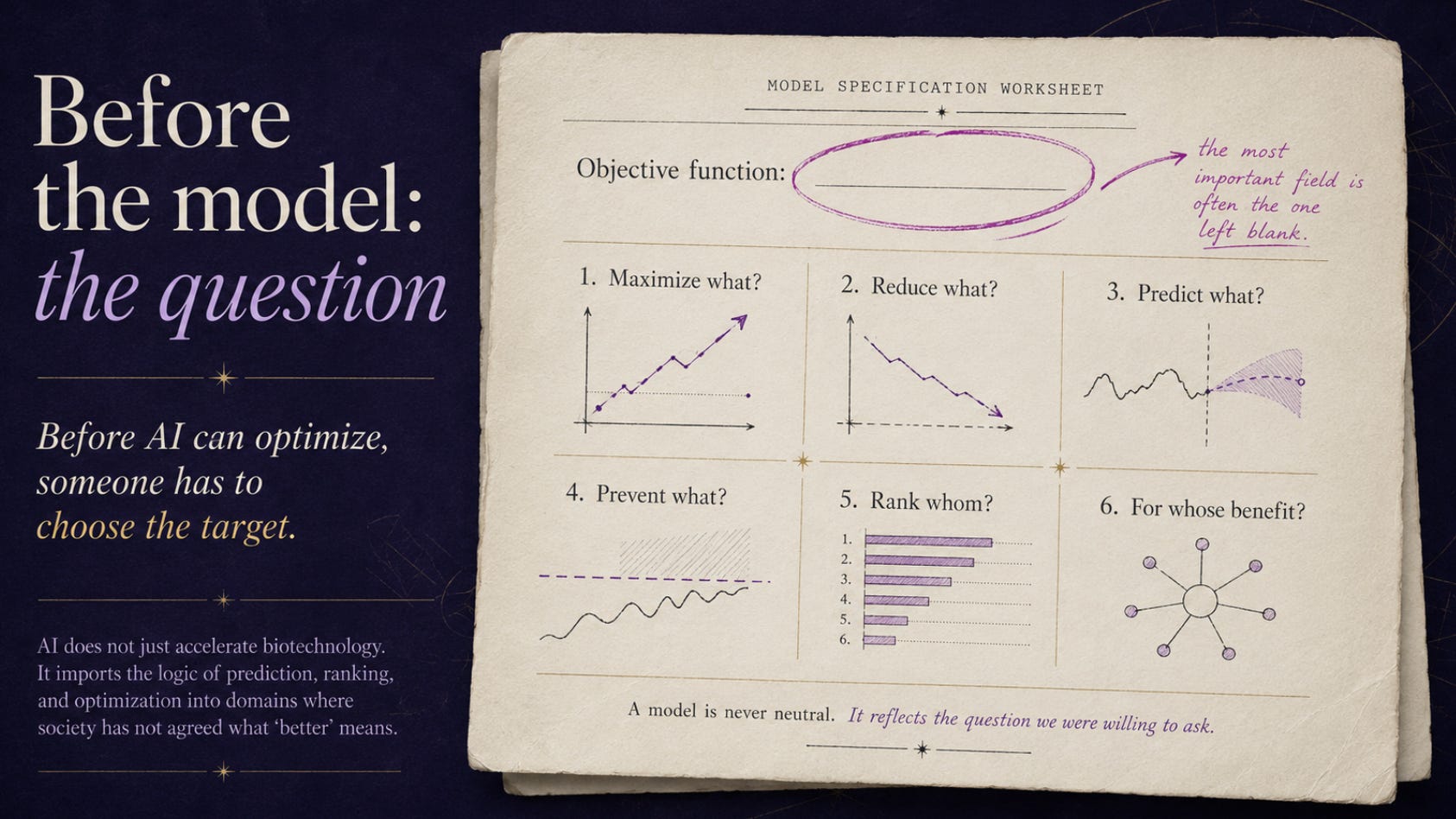
That creates a challenge we rarely confront directly. As a society, have we actually asked who we want to become? Have we decided what kinds of human differences should be preserved, what kinds of suffering should be alleviated, and what kinds of enhancement we are willing to pursue? Or are we allowing markets, technological capabilities, and competitive pressures to answer those questions by default?
Will systems designed to predict, rank, and optimize begin to define what improvement means? And if they do, who benefits?
Who is left behind? What new divides emerge between those who can access these technologies and those who cannot? History suggests that innovation rarely distributes its benefits evenly. Without deliberate governance, advances intended to improve human life can also deepen existing inequalities and create new forms of social stratification.
CRISPR is no longer speculative: Casgevy, a CRISPR/Cas9-edited stem-cell therapy, is already approved in major markets for eligible patients with sickle cell disease and transfusion-dependent beta thalassemia. AI models can help predict how changes in DNA may affect gene activity, and scientists are using machine learning to understand gene expression, protein structure, and cellular behavior at scales that would have been unimaginable a generation ago. Embryo editing itself is already experimentally real, even though reproductive embryo editing remains outside clinical medicine, but its continued development reopens a question society has never answered well: who gets to decide which futures are worth engineering?
The old ethical debate often got trapped in the language of the natural.
Is genetic engineering unnatural?
But humans have always altered the conditions nature gave them. The line between natural and unnatural has never been clear. To some extent agriculture is unnatural. Houses are unnatural. Glasses are unnatural. Anesthesia, antibiotics, IVF, organ transplantation, insulin, airplanes, and vaccines are all interventions that reshape or overcome biological limits. “Natural” is not the same as good. Disease is natural. Pain is natural. Maternal death is ‘natural’. Infant mortality is ‘natural’.
The better question is not whether a technology is natural. The better question is: what does it optimize for?
That is where genetic engineering becomes inseparable from AI.
AI systems are built around objective functions. They need targets. Maximize engagement. Minimize error. Predict risk. Increase conversion. Improve accuracy. Rank relevance. Reduce cost. Optimize outcome.
But human life resists clean objective functions.
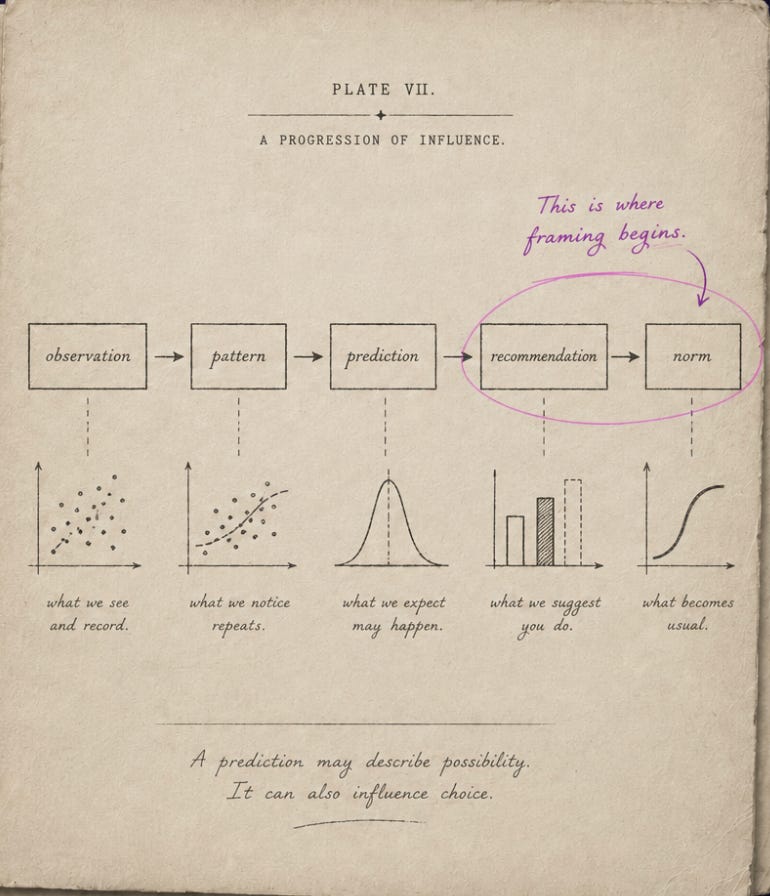
In commerce, optimization already changes desire. Recommendation systems do not merely respond to taste. They shape it. They learn from behavior that they have already influenced, creating loops in which users and systems train each other. Over time, the system can make people more predictable, more similar, more reachable, more monetizable.
Now imagine that logic taken to the extreme in genetics:
Which trait is ‘best’?
Which enhancement becomes normal once it is available?
Which parents can afford the safer version of the future?
A more uncomfortable possibility is that new forms of selection may not arrive as coercion. They may arrive as choice, care, risk reduction, and the desire to give a child the best possible future.
That is what makes it difficult.
The most difficult ethical questions may come from ordinary people acting under ordinary pressures: to prevent suffering, to reduce risk, to compete, to protect, to give a child every advantage. Even without coercion, markets can create pressure by making optimization feel like the only responsible choice.
This is especially charged in women’s health because the female body is where many of these futures become physically enacted.
Fertility treatment, egg freezing, IVF, embryo testing, pregnancy, prenatal screening, miscarriage, surrogacy, donor eggs, reproductive labor. The ethics of genetic technology are often discussed in abstract language, but they enter the world through clinics, bodies, hormones, procedures, costs, risks, and choices that are unequally distributed.
Women’s bodies are often where society’s debates become physically real.
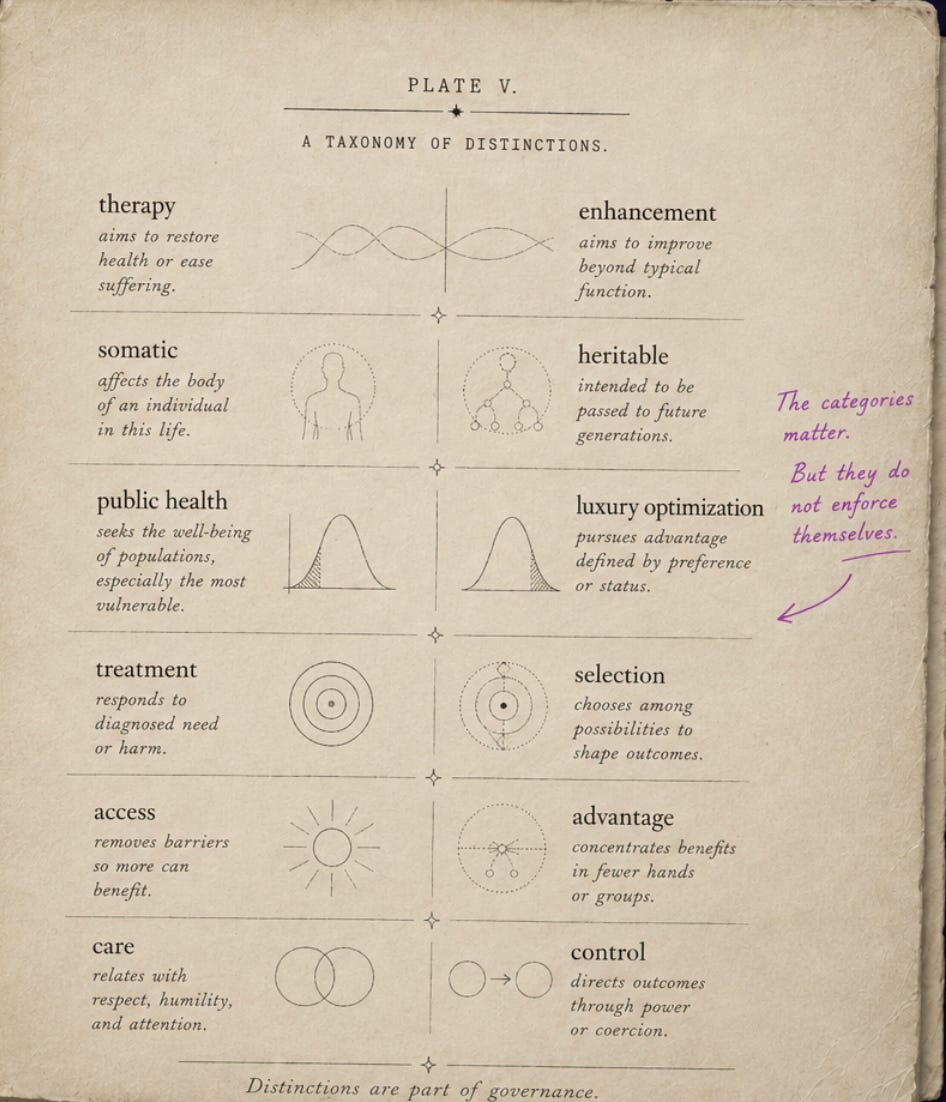
That doesn’t mean we should reject genetic engineering. That would be too simple and, in many cases, morally wrong. A therapy that relieves devastating disease is not equivalent to enhancement. Treating sickle cell disease is not the same as ranking embryos for speculative traits. Public health use is not the same as luxury optimization. Somatic editing is not the same as heritable editing.
Every age has a dominant idea about what it means to become a better human being.
Different institutions define that ideal in different ways. Religious traditions often focused on moral or spiritual transformation. Nation-states emphasized duty, citizenship, and collective identity. Industrial societies rewarded productivity and efficiency. Consumer culture elevated choice and self-expression. Today’s wellness industry often frames health as a project of continual optimization. AI promises better prediction and decision-making, while biotechnology raises the possibility of directly altering biological traits themselves.
The myth of our time may be that everything can be improved if only it can be measured, predicted, edited, and optimized.
But improvement is not neutral.
For whom?
At what cost?
According to which model of the good life?
With whose data?
Under whose governance?
To preserve what kind of human future?
This is why the next frontier is not only scientific. It is social and political. Perhaps even mythological.
It is also why conversations about biotechnology increasingly resemble conversations about AI governance. Both technologies are advancing rapidly. Both have the potential to reshape economies, institutions, identities, and everyday life. Both raise questions that are not merely technical but collective: what kind of future do we want, who gets to decide, and how should power be distributed when technologies can alter the conditions of human life itself?
Yet in both domains, public consultation has struggled to keep pace with innovation. Decisions with profound social consequences are often made by a relatively small group of companies, investors, and policymakers, while the broader public is invited into the conversation only after key trajectories have already been established.
There is an interesting asymmetry, however. AI has become highly visible. It dominates headlines, boardrooms, policy agendas, and public imagination.
Biotechnology remains comparatively invisible to many people despite its enormous implications.
People encounter AI directly in their daily lives; far fewer understand how advances in genetics, reproductive technologies, synthetic biology, or gene editing may shape the decades ahead.
In some ways, biotechnology today resembles where AI was a few years ago: advancing rapidly beneath the surface of public awareness. Yet in other ways biotechnology may offer lessons that AI governance has not yet fully absorbed. The biotechnology community has, at critical moments, demonstrated a willingness to pause, establish moratoriums, and create international frameworks before certain capabilities moved forward. Those efforts have been imperfect, but they reflect an acknowledgment that not everything that can be done should be done immediately.
AI and biotechnology have much to learn from one another. Both require governance that is proactive rather than reactive. Both require public legitimacy, not just technical expertise. And both force us to confront questions that cannot be answered by markets alone.
We need democratic processes capable of engaging with these technologies before their futures become irreversible.
Not symbolic public input after companies have already made the key decisions. Not ethics committees that simply ratify what is already underway. We need genuine public debate, meaningful oversight, and a shared framework for distinguishing between healing and enhancement, innovation and exploitation, empowerment and control.
That challenge feels especially urgent in Geneva this year, around the Global Dialogue on AI Governance. The UN’s preliminary scientific report on AI frames the issue as one of pace, measurement, and real-world deployment: AI capabilities are advancing quickly, governance and evaluation methods are struggling to keep up, and the benefits of AI in science and health depend on the systems, institutions, workflows, and contexts into which these tools are deployed. It also emphasizes that AI should not be evaluated as a model alone, but as a deployed system: the model, the tools, the environment, and the users.
That matters for medicine, and especially for genetic engineering, because the stakes do not lie only in prediction. They lie in what prediction becomes connected to. In health, AI may help identify risk, guide triage, accelerate discovery, or support clinical decisions. In biotechnology, those predictions may eventually sit closer to interventions in bodies, reproduction, disease, inheritance, and human possibility. The governance question is therefore not only whether the model works. It is what the model is helping make possible, under whose authority, and according to which definition of benefit.
The question is who gets to shape the rules, incentives, and values that guide their development.
This is why governance cannot be treated as a purely technical exercise. Beneath every regulatory framework sits a deeper question about what kind of future we are trying to build. What kinds of risks are acceptable? What kinds of interventions should remain off limits? What counts as healing, and what counts as enhancement? Which decisions belong to markets, which belong to governments, and which belong to society as a whole?
These are not scientific questions. They are political, cultural, and ultimately human questions.
If an algorithm can predict your choices before you make them, it raises uncomfortable questions about agency and free will. If machines surpass human cognitive limits, it challenges our status, our sense of self.
The question society has to answer is not only whether we can redesign biology or build more powerful intelligence, it seems, increasingly, the answer is that we can. It is how much of human agency we are willing to outsource in the process.
Together they raise a deeper question than either technology alone: not simply what is possible, but what should be pursued. What counts as progress? Who gets to define improvement? Which risks are acceptable, and which futures are worth protecting?
The central challenge is not only how to regulate these technologies. It is whether our institutions are capable of creating legitimate, democratic ways to decide what these technologies are for, and whose vision of the future they ultimately serve.
Love the philosophical breakdown of who actually should own and define the governance framework for women's health in general. I have been in the finance industry building out AI tools and there is very rigorous process and framework on what's the appropriate model to use for what use cases. I am new to the women's health space and reading some of the articles here on the gaps within the existing infra of women's health and the lack of support within the framework seems a little concerning, on top of all the ongoing AI development.